
What players say
Stick Huggy Cooperative Arcade leans on a single strong idea: two characters, one timer, and a shared finish line. The hand collection requirement prevents players from simply sprinting to the portal, while the countdown punishes hesitation and poor communication. Simple directional controls keep the barrier low, making it accessible for families and casual groups. The main limitation is that the input does not describe level variety or difficulty scaling, so replay value depends on how much players enjoy mastering the same coordination challenge.
About this game
Two Sticks, One Goal
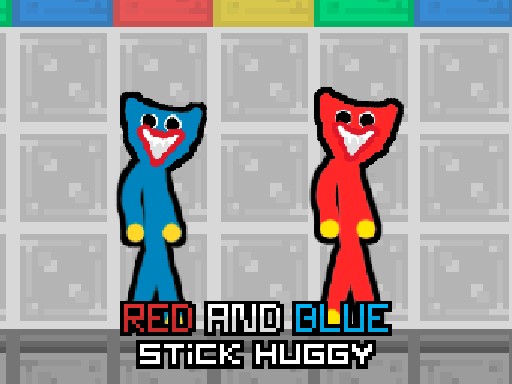
Stick Huggy Cooperative Arcade puts two stick figures—the huggy brothers—under player control at the same time. One is red, one is blue, and each has a separate set of directional inputs. The shared objective is simple: gather every red and blue hand scattered across the stage, then bring both characters to the black portal at the finish line. Neither brother can be left behind; the level only ends when both arrive. That single rule shapes every decision, because splitting up to grab hands faster often means one character reaches the portal while the other is still exposed to the countdown.Hand Collection and Route Planning
Hands are placed along the path, not in a straight line, so collecting them requires detours. Players must decide who grabs which hand and when to regroup. A hand near a hazard might be safer for the red character to take while blue holds a position, or vice versa. Because the timer keeps running, every second spent planning is a second not spent moving. The most efficient runs come from players who memorize hand locations and assign roles before the level starts, rather than reacting on the fly.Timer Pressure and Obstacle Timing
The countdown timer is the main source of tension. It does not pause for mistakes, and it does not care which character is ahead. Obstacles along the route require synchronized movement—if one player rushes through a gap, the other may miss the window and lose time recovering. Staying calm matters more than raw speed. Players who panic tend to overcorrect, bump into obstacles, and waste the seconds they were trying to save.Playing Solo or With a Partner
The game is built for two people, each controlling one stick figure, but a single player can manage both characters simultaneously. Solo play turns the game into a coordination exercise, similar to patting your head and rubbing your stomach while walking. With a partner, the challenge shifts to communication: calling out hand positions, warning about obstacles, and agreeing on who goes first through tight spaces. Both modes use the same levels and timer, so the difficulty comes from how well you manage two inputs at once, not from separate modes.Who This Arcade Game Suits
Short levels and straightforward directional controls make Stick Huggy Cooperative Arcade easy to pick up. The family-friendly presentation and lack of complex inputs mean younger players can join without a long learning curve. The real difficulty sits in coordination and timing, which keeps the game engaging for older players who want a quick cooperative challenge. It works best for friends or family members who enjoy talking through a level together rather than competing against each other.Compatibility
This H5 game runs smoothly on:
• Desktop computers (Windows / Mac) • Mobile phones (iPhone / Android)
• Tablets (iPad / Android)
🌐 Best experienced with Chrome, Safari, or Edge
FAQ
Can Stick Huggy Cooperative Arcade be played by one person?
Yes. The game is designed for two players, but a solo player can control both stick figures at once. This means managing two sets of directional inputs simultaneously, which is harder than it sounds. Solo play is best for learning level layouts before bringing in a partner.
What happens if only one character reaches the black portal?
The level does not end until both characters reach the portal. If one arrives early, that character waits while the other must still navigate the remaining path and collect any missed hands. The timer keeps running, so leaving one behind usually costs the run.
Do players need to collect every hand to finish a level?
Yes. Collecting all red and blue hands is part of the objective. The portal only becomes the finish line once the hand collection requirement is met. Skipping hands means the level cannot be completed, even if both characters reach the portal area.
Is Stick Huggy Cooperative Arcade suitable for young children?
The game is described as family-friendly with simple directional controls, so it can suit younger players. The main challenge is coordination and timer pressure rather than complex inputs. Children who can handle two-button movement and follow a countdown should be able to participate.
What makes the timer a problem during cooperative play?
The countdown does not pause when players talk or make mistakes. In two-player mode, discussing who grabs which hand takes time away from movement. The timer forces quick decisions, so players who plan routes in advance tend to finish more consistently than those who improvise.
Are there different level designs in Stick Huggy Cooperative Arcade?
The input mentions a series of levels with hands scattered along the path and obstacles to avoid. Specific level count and themes are not stated. Players can expect each stage to require a different route and timing approach, but exact variety is not detailed in the available description.
Player Comments
Sign in to comment
You must be logged in before posting a review or rating.
No comments yet. Be the first to comment!








Editorial Notes